
OneDrive Collection
A OneDrive Collection enables SearchBlox to connect to your Microsoft OneDrive or SharePoint environment using Azure AD authentication and index files and folders for search.
Once configured, users can search OneDrive and SharePoint content directly from the SearchBlox search interface without needing to switch between applications.
Before You Begin
Before configuring a OneDrive Collection, ensure you have the following:
-
An Azure AD application registration with the following details:
- Client ID
- Client Secret
- Tenant ID
-
An Access Token and Refresh Token obtained from your Azure AD application's OAuth 2.0 configuration.
-
The Drive ID of the OneDrive or SharePoint document library you want to index. This can be retrieved using the Microsoft Graph Explorer.
-
A defined Root Path:
- Use
/to index all files and folders within the drive. - Specify a folder path such as
/Documents/Reportsto index only a specific folder and its contents.
- Use
Creating a Onedrive Collection
You can create a Onedrive Collection by following these steps:
-
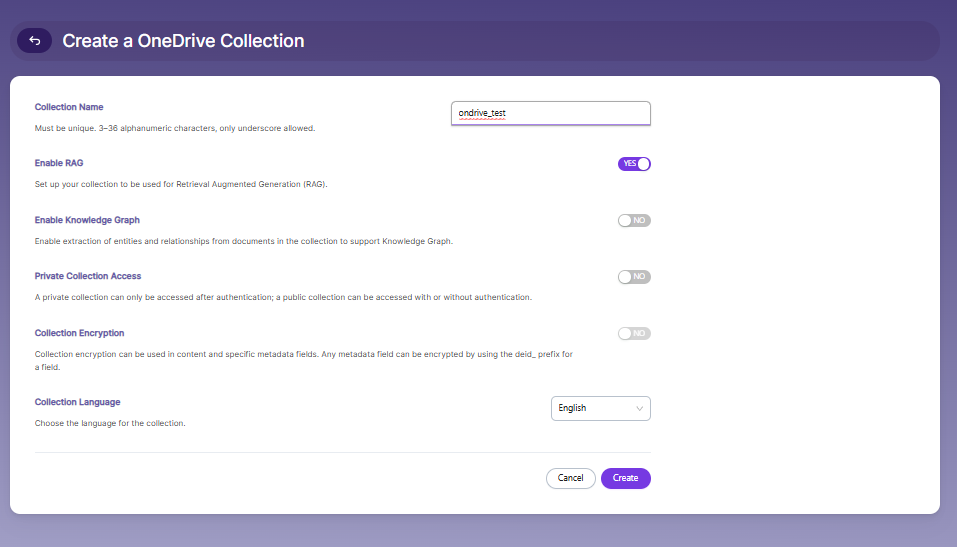
Log in to the Admin Console, go to the Collections tab, and click Create or the “+” icon.
-
Select Onedrive Collection as the collection type.
-
Enter a unique name for the collection. The name must contain 3–36 alphanumeric characters, and only underscores (_) are allowed.
-
Enable or disable RAG (Retrieval Augmented Generation) depending on your requirement. Enable it if the collection will be used for AI-powered search or chatbot responses.
-
Enable Knowledge Graph if you want SearchBlox to extract entities and relationships from the documents in the collection.
-
Choose whether the collection should be Private or Public. Enable Private Collection Access to restrict the collection to authenticated users only.
-
Configure Collection Encryption if you want to encrypt document content or specific metadata fields.
-
Select the Collection Language based on the language used in the documents. The default language is English.
-
Click Create to create the OneDrive Collection.
-
After the collection is created, you will be redirected to the OneDrive Settings / Authentication section to configure the connection and access details.
Configuring OneDrive Settings
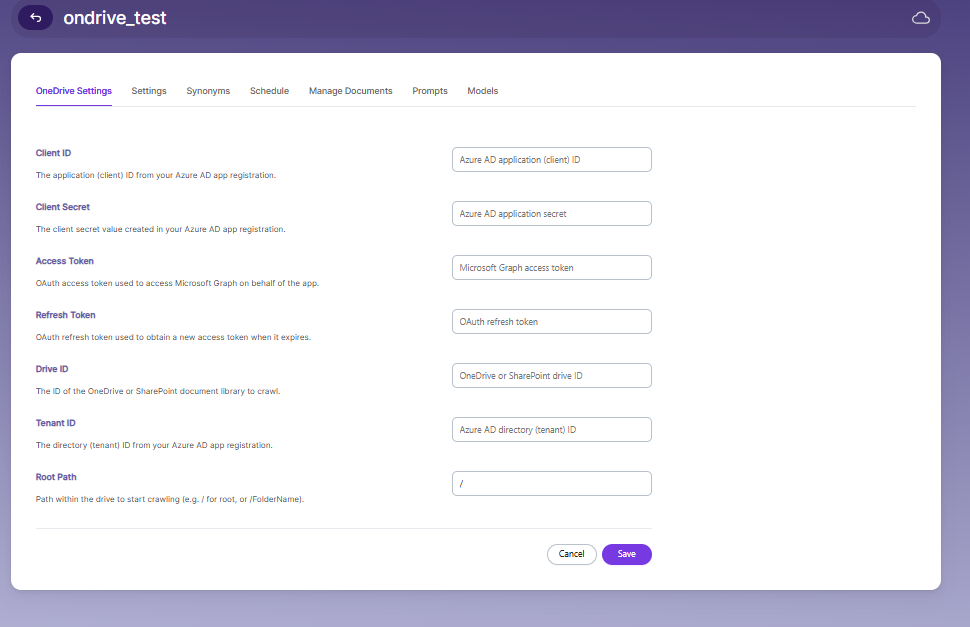
To configure OneDrive or SharePoint integration for your collection, follow these steps:
-
Go to the OneDrive Settings tab within the collection.
-
Enter the Client ID.
This is the Application (Client) ID obtained from your Azure Active Directory (Azure AD) app registration. It uniquely identifies your application. -
Enter the Client Secret.
Provide the client secret generated in your Azure AD app registration. This is used for secure authentication. -
Enter the Access Token.
This is the OAuth access token used to access Microsoft Graph APIs on behalf of the application. It allows temporary access to OneDrive or SharePoint resources. -
Enter the Refresh Token.
The refresh token is used to generate a new access token when the current one expires, ensuring continuous access without re-authentication. -
Enter the Drive ID.
Specify the unique ID of the OneDrive or SharePoint document library that you want to crawl and index. -
Enter the Tenant ID.
This is the Directory (Tenant) ID from your Azure AD. It identifies your organization within Microsoft’s cloud services. -
Enter the Root Path.
Define the starting path within the drive for crawling.- Use
/for the root directory - Or specify a folder path like
/Documents/Reports
- Use
-
Click Save to store the configuration and enable the system to access and index files from OneDrive or SharePoint.
Collection Settings
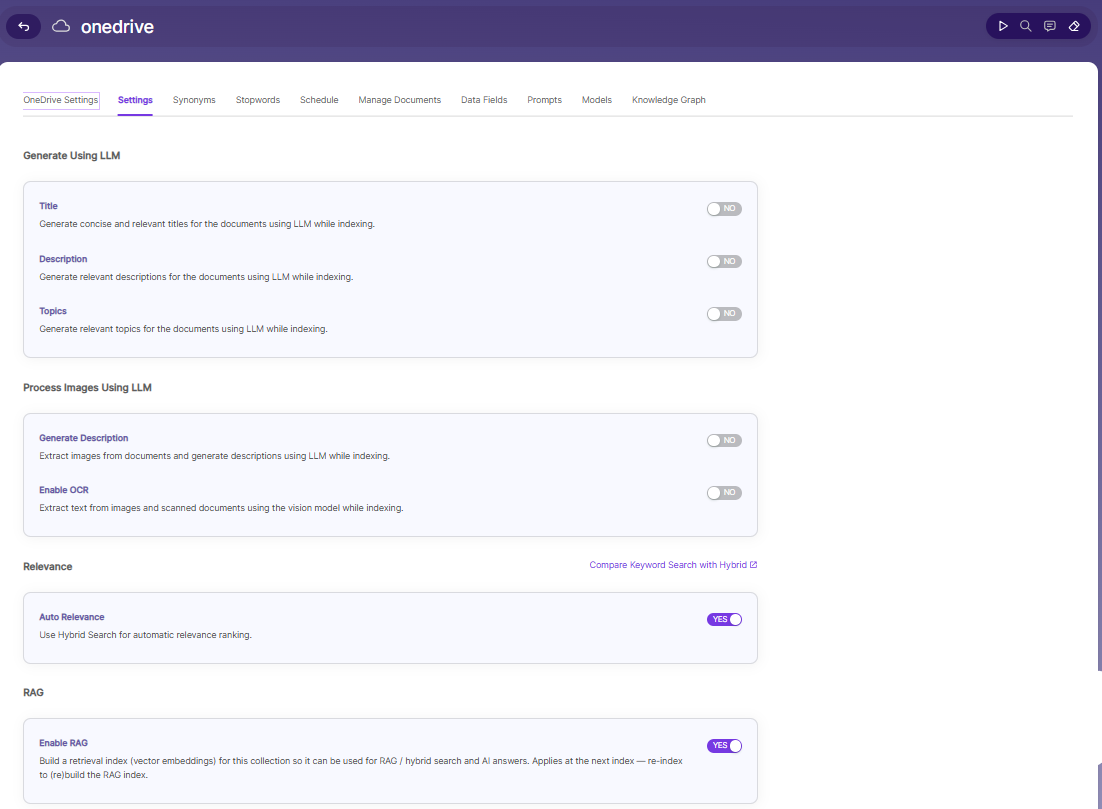
Generate Using LLM
- Enable Title to automatically generate concise and relevant titles for the documents using LLM while indexing.
- Enable Description to generate relevant descriptions for the documents using LLM while indexing.
- Enable Topics to generate relevant topics for the documents using LLM while indexing.
Process Images Using LLM
- Enable Generate Description to extract images from documents and generate descriptions using LLM while indexing.
- Enable Enable OCR to extract text from images and scanned documents using the vision model while indexing.
Relevance
- Auto Relevance — Enable to use Hybrid Search for automatic relevance ranking. Compare Keyword Search with Hybrid to evaluate the difference before enabling.
RAG
- Enable RAG — Turn ON to build a retrieval index (vector embeddings) for this collection so it can be used for RAG, Hybrid Search, and AI Answers. This setting applies at the next index — re-index the collection to build or rebuild the RAG index.
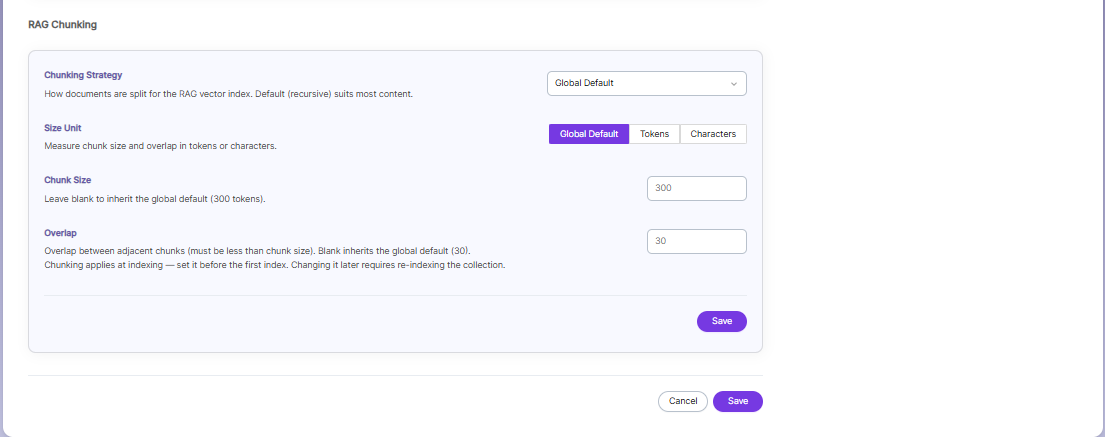
RAG Chunking
-
Chunking Strategy — Determines how documents are split for the RAG vector index. Default (recursive) suits most content.
-
Size Unit — Measure chunk size and overlap using one of three modes:
- Global Default — Inherits the system-wide default chunking configuration.
- Tokens — Measure chunk size and overlap in tokens.
- Characters — Measure chunk size and overlap in characters.
-
Chunk Size — Leave blank to inherit the global default (300 tokens).
-
Overlap — Overlap between adjacent chunks; must be less than the chunk size. Leave blank to inherit the global default (30).
Note: Chunking applies at indexing — set it before the first index. Changing it later requires re-indexing the collection.
Click Save to apply the RAG Chunking configuration, or click Cancel/Save at the bottom of the page to discard or store all Collection Settings.
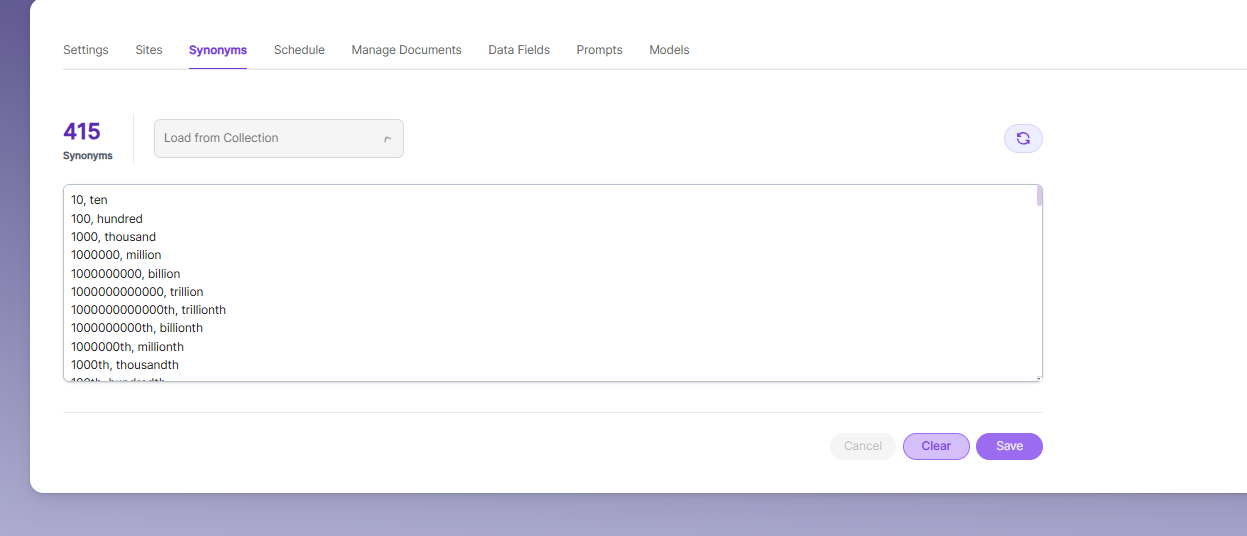
Synonyms
Synonyms help the search show relevant documents even when the exact search word is not used.
For example, if someone searches for “global,” the results can also include documents that use “world” or “international.”
We have an option to load Synonyms from the existing documents.
Stopwords
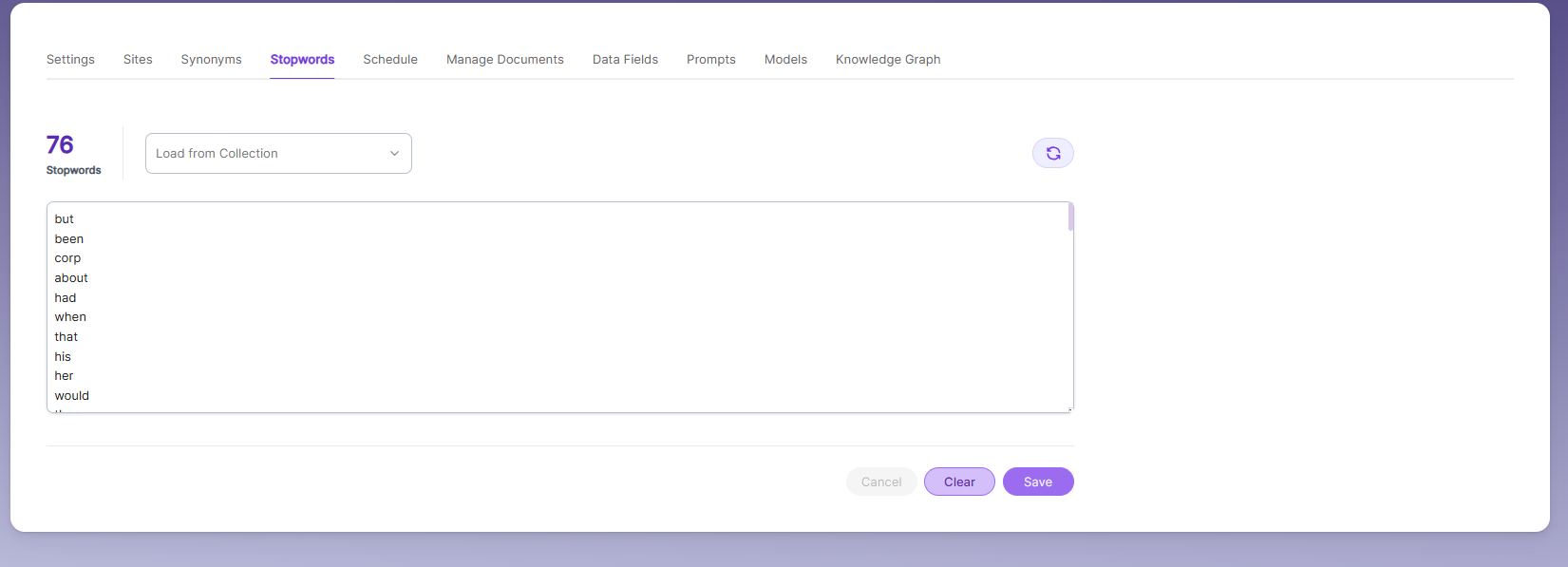
Stopwords are common, high-frequency words that carry minimal semantic value and are typically excluded during text processing, indexing, or search operations. Examples include articles (a, an, the), conjunctions (and, but, or), prepositions (in, on, about), and auxiliary verbs (is, was, would, had).
Purpose:
Reduce noise in search indexing and text analysis
Improve processing efficiency by excluding low-value tokens
Enhance search relevance by prioritizing meaningful keywords
Schedule and Index
Sets the frequency and the start date/time for indexing a collection. Schedule Frequency supported in SearchBlox is as follows:
- Once
- Hourly
- Daily
- Every 48 Hours
- Every 96 Hours
- Weekly
- Monthly
The following operation can be performed in Azure blob collections
| Activity | Description |
|---|---|
| Enable Scheduler for Indexing | Once enabled, you can set the Start Date and Frequency |
| Schedule | For each collection, indexing can be scheduled based on the above options. |
| View all Schedules | Redirects to the Schedules section, where all the Collection Schedules are listed. |
Manage Documents Tab
-
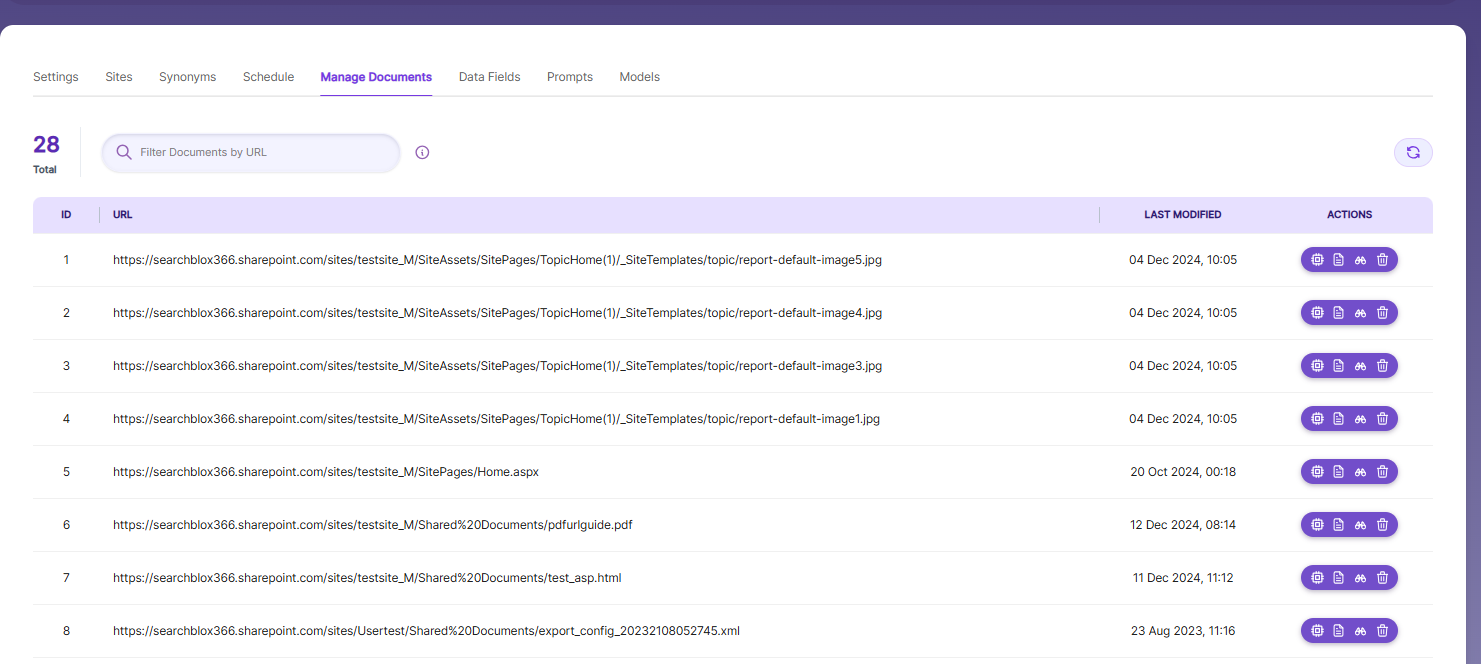
Using Manage Documents tab we can do the following operations:
- Filter
- View content
- View metadata
- Refresh
- Delete
-
To delete a file from your collection, enter the file path and click "Delete".
-
To see the status of an indexed file, click "View Metadata".
 Data Fields Tab
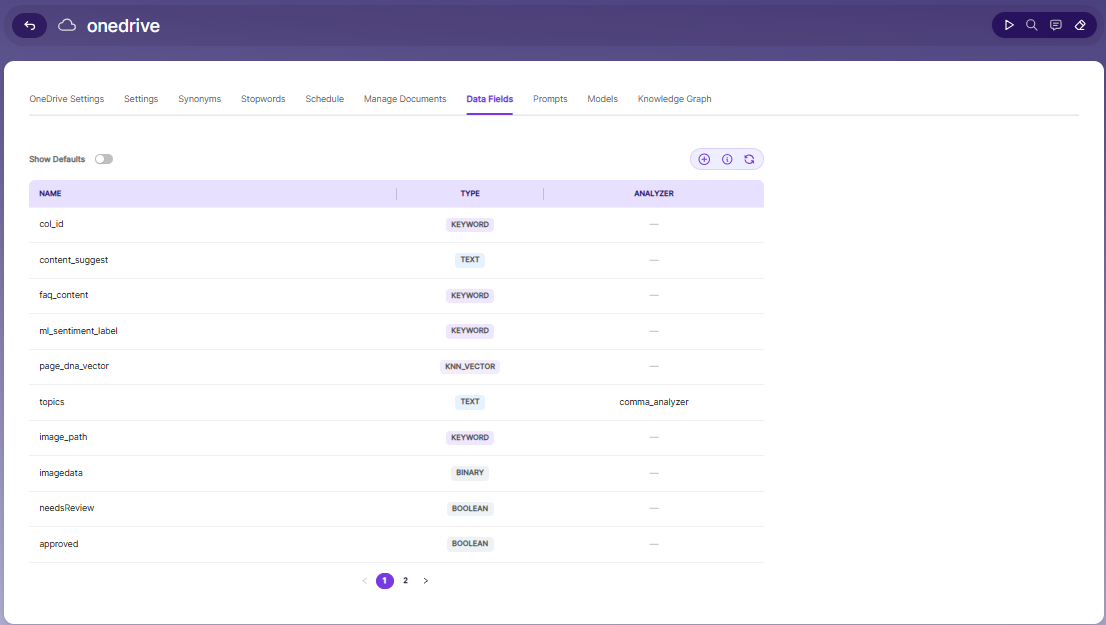
Using the Data Fields tab, you can create custom fields for search and view the default and configured fields for the collection.
- Toggle Show Defaults ON to display the collection's default system fields, in addition to any custom fields.
- Use the + icon to add a new custom Data Field.
- Use the info icon to view details about field configuration.
- Use the refresh icon to reload the fields list.
Each field is listed with the following columns:
Column Description Name The name of the data field (e.g., col_id,content_suggest,topics).Type The data type assigned to the field. Analyzer The text analyzer applied to the field, if any (e.g., comma_analyzer). Shown as—when no analyzer is applied.SearchBlox supports the following Data Field types:
Type Description Keyword Used for alphanumeric values such as IDs, tags, codes, or other exact-match fields (e.g., col_id,faq_content,image_path).Text Used for full-text search within custom field content (e.g., content_suggest,topics).KNN_Vector Used to store vector embeddings for semantic/similarity search (e.g., page_dna_vector).Binary Used to store binary data such as images or files (e.g., imagedata).Boolean Used for true/false values (e.g., needsReview,approved).Number Used for numeric values such as prices, quantities, ratings, or counts. Date Used for date values that can be searched, sorted, and filtered. Note: Once Data Fields are configured, the collection must be cleared and re-indexed for the changes to take effect.
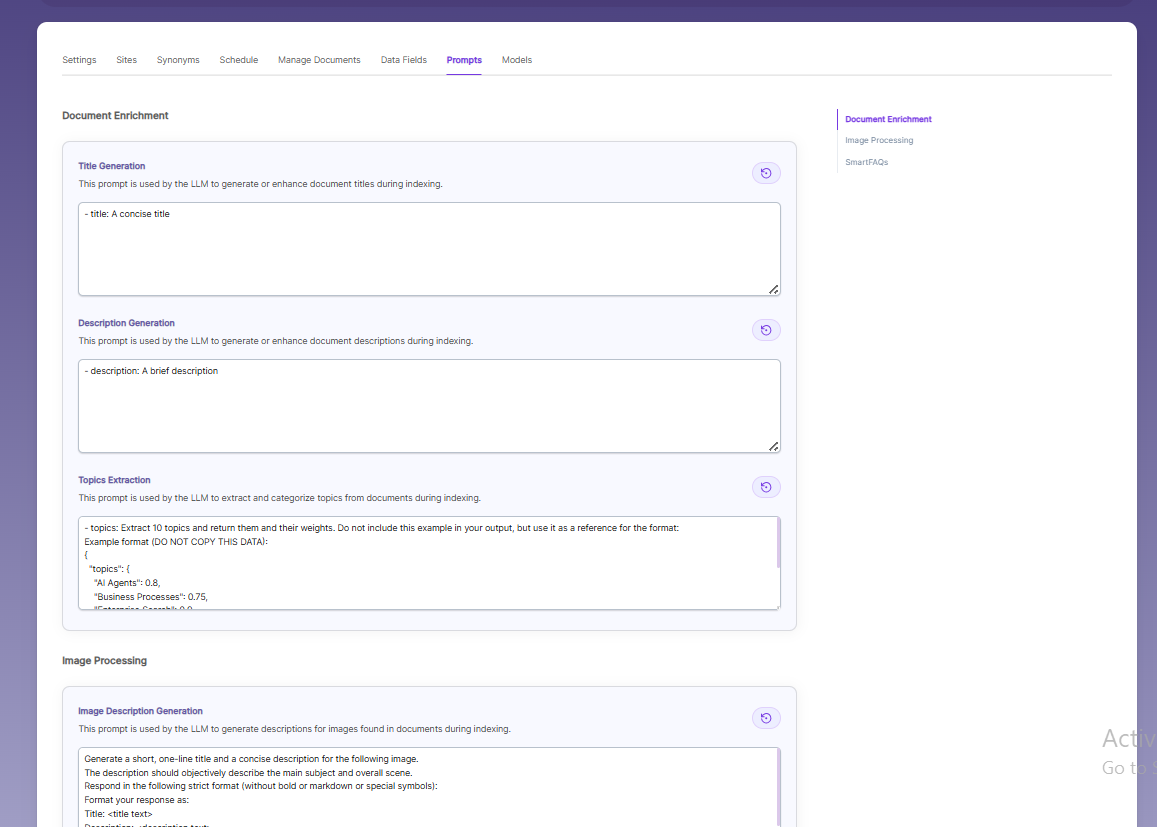
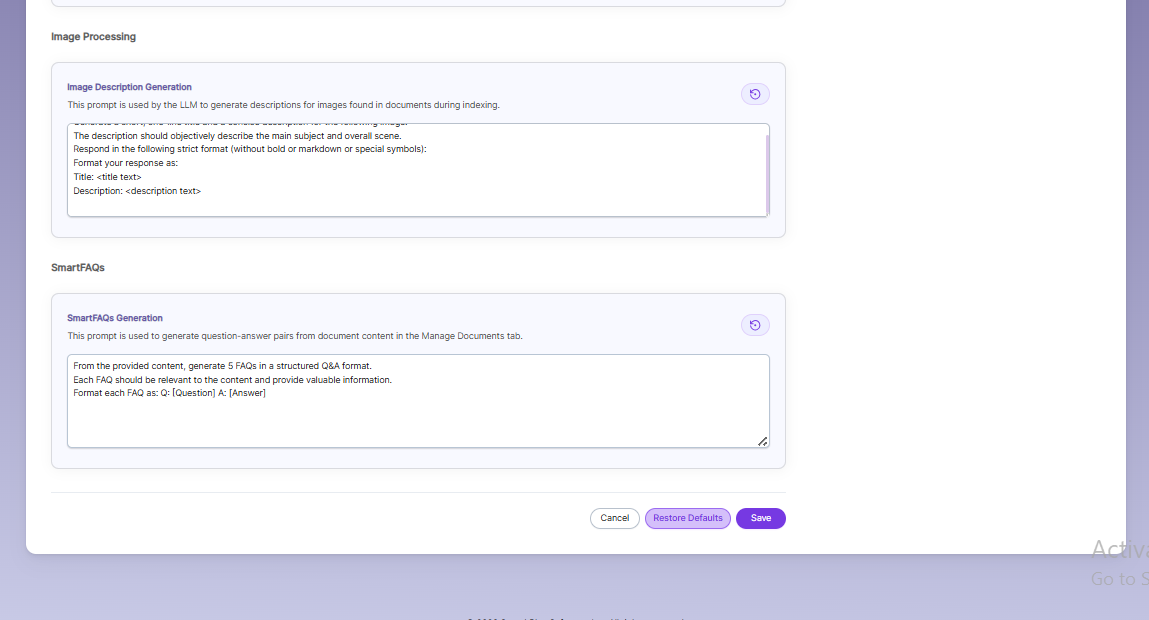
Prompts
- When LLM/RAG is enabled, you can edit AI-based prompts for Title, Description, Topic, Image Description, and Smart FAQs.
- You can customize these prompts anytime, and use Restore Default to reset them back to the original SearchBlox settings.
OneDrive Collection Models
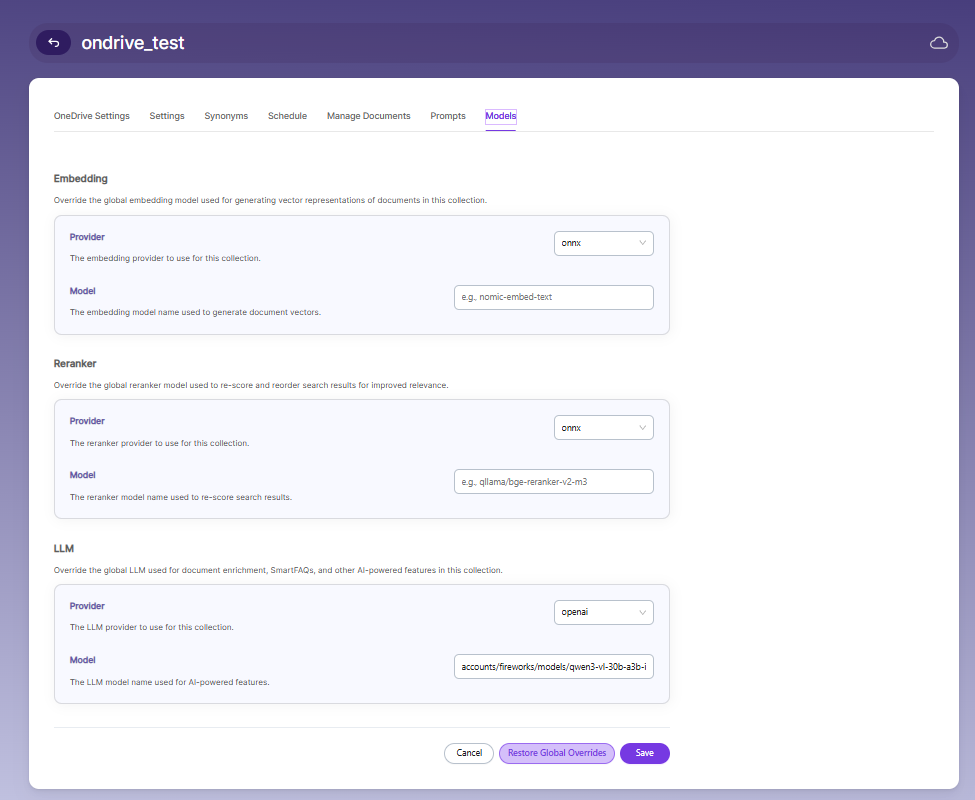
The Models page allows you to configure and override AI models used for embeddings, reranking, and LLM-based features within the collection.
Embedding
- Provider specifies the embedding provider used to generate vector representations of documents.
- Model defines the embedding model used to convert document content into vectors for semantic search.
Reranker
- Provider specifies the reranker provider used for improving search result relevance.
- Model defines the reranker model used to re-score and reorder search results based on relevance.
LLM
-
Provider specifies the Large Language Model provider used for AI-powered features.
-
Model defines the LLM used for tasks such as document enrichment, summaries, and SmartFAQs.
-
These settings override global configurations and apply only to the current collection.
Knowledge Graph
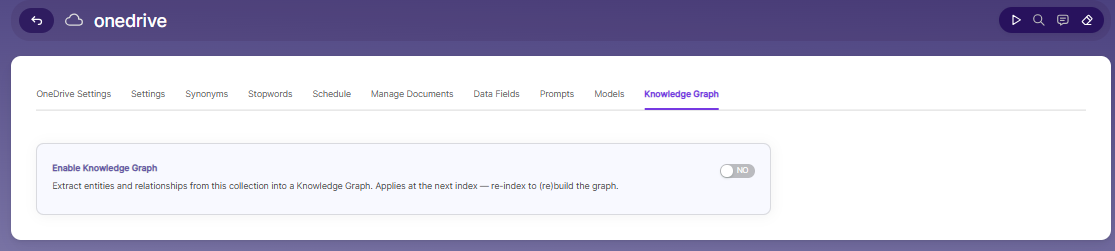
- Enable Knowledge Graph — Turn ON to extract entities and relationships from this collection into a Knowledge Graph. This setting applies at the next index — re-index the collection to build or rebuild the graph.
Updated 23 days ago